June 2026
We rebuilt our agents around missions. Our org chart didn't get the memo.
Every AI team ships specialized subagents, one job each. Then those same people walk into a standup organized like it's 2014.
The problem
Your org chart is a monolith. You’d never ship software like this.
Nobody builds one giant do-everything agent. You build small, bounded ones — one per task, one per doc — designed around the outcome.
Now look at your org. Permanent frontend team, permanent backend team, permanent QA. Fixed rows, planted in the same spot every season, whether or not that’s where the work is.
We spent two years learning to decompose problems into correctly sized agents. Then we went back to running humans like a monolith and called it stability.
The trap
The people building agent systems already stopped doing this. To themselves.
The engineers most fluent in mapping agents to bounded tasks sit inside the most rigid human structures. They’ll spin up five agents before lunch, then wait a quarter for a reorg to move one person to where the work is.
“We need a frontend team and a backend team” felt like structure. It was a default. A garden planted in permanent rows looks organized right up until the light shifts and half of it is growing in shade.
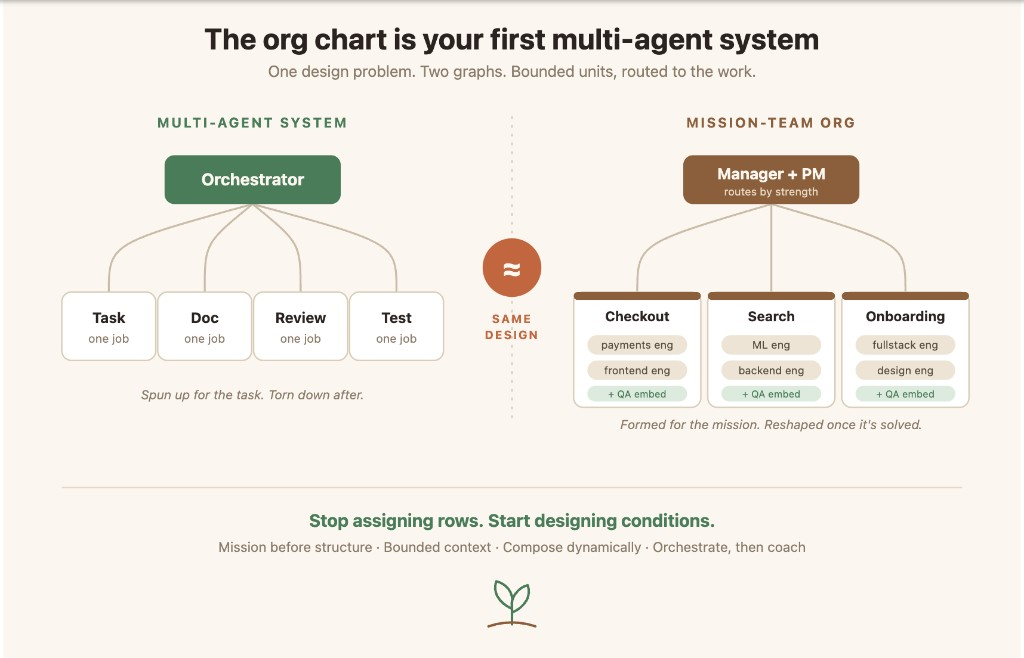
Not a new idea, to be fair — Red Hat runs tiger teams across more than 500 engineers, Spotify had squads. What nobody says out loud: the org chart is an agent graph. Same design problem. We just keep treating org design and agent orchestration as two conversations. They’re one.
The framework
Four pillars: build the team like you’d build the system
Call them mission teams, tiger teams, context teams — the name matters less than the four rules underneath. One team, one mission.
Mission before structure. Define the outcome first. Ask what capabilities the goal needs — don’t inherit “frontend and backend” before you’ve asked. Plant for the harvest you want, not the rows you had.
Bounded context per team. An agent owns one job. A mission team owns one mission, end to end. No committee, no “wait, who owns this?”
Dynamic composition. Agents spin up and tear down as the work changes. Teams should too. This is the pillar that makes people flinch, because it threatens permanent reporting lines. You don’t leave last season’s plants in the ground because you’re attached to them.
Manager as orchestrator and coach. The one people get wrong. The manager stops owning the task box — not the person. Career growth, wellbeing, coaching judgment: all stays. What changes is you route people to missions by strength instead of assigning tasks.
The pushback
Three objections I get every time
“Can’t an agent just replace the manager?” Routing and tracking — yes, automate it. Reading burnout before anyone says the word, knowing when to push and when to stand in front of someone, accountability in a hard week — no. Route with a machine. Trust stays human.
“If teams are fluid, what happens to PMs?” Separate product ownership from execution team membership. The PM stays constant — roadmap, customer context. What flexes is who executes. The PM is the stable orchestrator; the bench underneath flexes.
“And QA?” Different plant, different care. QA is fluid and standardized: rotating people who embed in whatever mission needs them, plus a thin, stable QA chapter that owns the shared playbook so standards don’t fragment. PM anchors. QA embeds but keeps one root system.
How you actually do this
The real blocker isn’t structure. It’s visibility.
Every objection reduces to one fear: I won’t see what my people are doing. Fix that and the resistance composts itself.
Build the human version of an orchestrator agent — a dashboard that reads where work already lives, instead of asking anyone to update a tracker they never will: commits from GitHub, tickets from Jira, docs from Confluence. It infers rather than interrogates: this person’s commits map to the checkout mission, tickets 70% done, doc touched two days ago.
The reframe that lands: you’re not blowing up reporting lines. The line stays — it just stops being a task boundary and becomes a channel for context and trust.
One last thing
The org chart is your first multi-agent system. Design it like one.
We already know how to do this. We do it to our agents every day: bounded units, spun up for the mission, orchestrated by something that routes to strengths. We just haven’t pointed the skill at the humans.
You don’t grow a garden by pulling on the plants. You fix the soil, manage the light, rotate with the seasons. Mission teams are the same move: stop assigning rows, start designing conditions.
Mission before structure. Bounded context. Compose dynamically. Orchestrate, then coach.
The agents already work this way. Your best people are ready to. The org chart is the last monolith — go refactor it.